

Table of Content
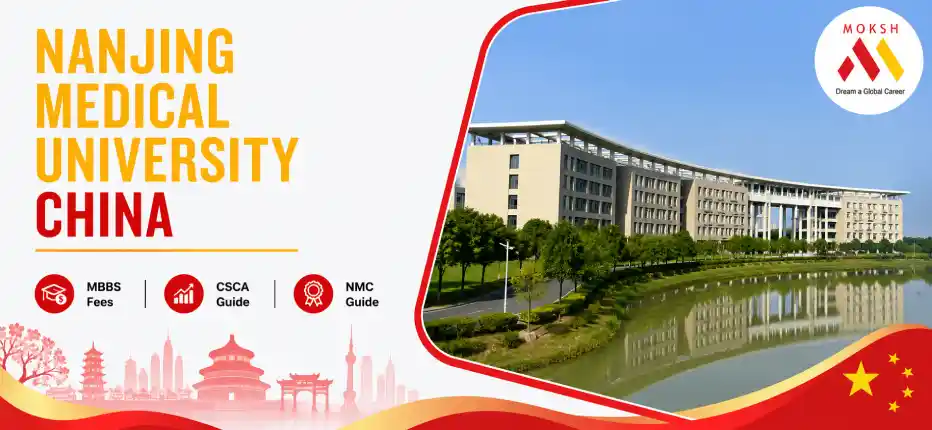
Nanjing Medical University is a public Medical University located in Nanjing city, China. It provides MBBS course conducted in English language so that Indian students can practice their medical profession in their home country. The program follows India's FMGL Regulations 2021, so graduates can sit for the FMGE or the NExT exam. The course runs six years: five years of classes and one year of hospital internship. Total cost for all six years, including tuition, hostel, and food, comes to about Rs.38 lakhs. That is far cheaper than most private medical colleges in India. This school works well for NEET-qualified students who want a recognized foreign degree without a huge price tag. Students also need to learn HSK-4 Mandarin before they start hospital rotations, and from 2026, they must clear a new entrance test called the CSCA.
Nanjing Medical University at a Glance
Nanjing Medical University China opened in 1934 in Jiangsu Province. It started as the Jiangsu Institute of Medical Administration and became a full university in 1993. The school is state-owned, not private. Some websites list it as private, but that is wrong. Three government bodies co-sponsor it: China's Ministry of Education, the National Health Commission, and the Jiangsu Provincial Government.
| Fact | Detail |
|---|---|
| Founded | 1934 |
| Ownership | Public (state-owned) |
| Campuses | Jiangning and Wutai |
| Global Ranking (THE 2026) | 801-1000 |
| China Medical Ranking | 26th |
| ESI Top 1% Disciplines | 9 |
The Jiangning campus handles early classes and lab work. The Wutai campus runs clinical teaching and hospital training.
Is Nanjing Medical University NMC-Approved for Indian Students?
Yes. The Clinical Medicine program at Nanjing Medical University MBBS complies to the Foreign Medical Graduate (FMGL) Regulations 2021 of India. After passing out the necessary licensing exams, graduates are allowed to practice in India.
Course length
FMGL rules require at least 54 months of study plus a 12-month internship. Nanjing Medical University runs a full 72-month program, split into five years of classes and one year of internship inside its own hospitals.
No online classes
India's Supreme Court and the NMC reject medical degrees earned online or through hybrid classes. Every class here happens in person, on campus or in a hospital.
English medium only
NMC registration needs a fully English-taught program. This university is one of the few Chinese schools approved by the Ministry of Education to teach Clinical Medicine entirely in English for international students. Skip any Chinese university offering a "bilingual" program; it will not qualify.
Two licenses, not one
Graduates need a Chinese medical license first. This means passing China's Medical Qualification Exam, called the CMQE, which is conducted in Chinese. That is one more reason Mandarin skills matter, even in an English-medium course.
Nanjing Medical University Eligibility Criteria for Indian Students (2026 Intake)
Getting into Nanjing Medical University depends on your board and your Class 12 marks.
| Criteria | Requirement |
|---|---|
| CBSE / ICSE Boards | Minimum 70% in Physics, Chemistry, Biology (PCB) |
| State Boards | Minimum 85% in PCB |
| Age | 18 to 25 years at enrollment (September) |
| Academic Gap | Gaps over 3 years need extra proof, such as clinical observation certificates |
These marks are checked closely. The university reviews your Class 12 transcript before it issues an offer letter. A gap year under three years needs no extra paperwork.
Nanjing Medical University Fees 2026: 6-Year Cost Breakdown
Money is often the biggest reason Indian families choose Nanjing Medical University over private colleges at home. A full MBBS seat in India can cost Rs.60 lakhs to Rs.1 crore. This university costs a fraction of that, because the Chinese government subsidizes public medical education.
| Cost Component | Annual Cost (RMB) | Annual Cost (INR approx.) | 6-Year Total (INR approx.) |
|---|---|---|---|
| Tuition | 34,000 | Rs.4,01,200 | Rs.24,07,200 |
| Hostel (double sharing) | 6,000 | Rs.70,800 | Rs.4,24,800 |
| Security Deposit (refundable) | 4,000 (one-time) | Rs.47,200 | Refunded at graduation |
| Registration Fee | 500 (one-time) | Rs.5,900 | Paid once |
| Residence Permit | 400 | Rs.4,720 | Rs.28,320 |
| Physical Exam | 540 (one-time) | Rs.6,370 | Paid once |
| Textbooks | 800 | Rs.9,440 | Rs.56,640 |
| Medical Insurance | 600 | Rs.7,080 | Rs.42,480 |
| Food & Utilities | 12,000 | Rs.1,41,600 | Rs.8,49,600 |
| Total Estimate | 54,000 | Rs.6,37,000 | Rs.38,35,000 |
All fees are paid in Chinese Yuan directly to the university. These figures use a rate of 1 RMB = Rs.11.80, and rates shift, so check the current exchange rate before you plan your budget. Within seven working days of your offer letter, you must pay a non-refundable deposit of 3,400 RMB to confirm your seat and get your visa documents. This amount later counts toward your first-year tuition.
If you are an Indian student who after NEET desires to do MBBS abroad, then this college is smart option. It has affordability offering high teaching standards.
Scholarships at Nanjing Medical University for Indian Students
Nanjing Medical University offers several ways to cut costs for strong students. Amounts and rules shift each intake, so confirm current numbers with the admissions office before you apply.
| Scholarship Type | Coverage | Who Qualifies |
|---|---|---|
| Nanjing Government Scholarship | Up to 10,000 RMB | Top academic performers |
| Entrance Scholarship | 5,000 to 8,500 RMB | High Class 12 or equivalent scores at admission |
| Jiangsu Jasmine Scholarship | Partial tuition or living support | Meritorious students selected by Jiangsu Province |
| Chinese Government Scholarship (CSC) | Full or partial tuition, plus a stipend in some cases | Top applicants who apply through the CSC portal |
Entrance scholarships get credited at admission time, so strong Class 12 marks pay off right away. The Chinese Government Scholarship is competitive, and many awards get reviewed again after your first year, based on attendance and grades. For most scholarships, renewal is based on yearly performance, rather than on your initial entry score.
Nanjing Medical University China Admission Process 2026: CSCA Exam and Interview
All applicants to the Chinese Government Scholarship universities will be required to sit for a new test called the China Scholastic Competency Assessment (CSCA) from the 2026 intake. The rule is being extended to self-funded students as well, and will be fully enforced by 2028.
The CSCA runs five times a year: January, March, April, June, and December. You can take it online from home or at a test center in India.
The interview tests your English language skills and why do you want a career in medicine. You will be asked questions such as: What are the primary functions of the kidneys?" or "Why do you want to become a doctor instead of a nurse or pharmacist?" Keep your answers simple and honest, and ground them in basic biology and chemistry.
Nanjing Medical University MBBS Curriculum: 6-Year Structure
The course at Nanjing Medical University moves step by step, from basic science to full hospital work.
| Year | Focus | Key Subjects |
|---|---|---|
| Year 1 | Foundational Sciences | Anatomy, Chinese Language, Physics, Chemistry, Math |
| Year 2 | Pre-Clinical Sciences | Physiology, Biochemistry, Microbiology, Systematic Anatomy |
| Year 3 | Paraclinical Sciences | Pharmacology, Pathology, Medical Genetics |
| Year 4 | Clinical Introduction | Diagnostics, Basic Surgery, Medical Ethics, Community Medicine |
| Year 5 | Clinical Specialties | Surgery, Gynecology, Pediatrics, Psychiatry, Emergency Medicine |
| Year 6 | Rotating Internship | 52 weeks inside affiliated Class A hospitals |
This structure matches what the USMLE, PLAB, and NExT exams expect. Returning students are not starting from zero when they prep for licensing exams back home.
Nanjing Medical University Clinical Training: Hospital Network and Internship
Real hospital experience is what makes or breaks a medical degree. Nanjing Medical University runs 24 affiliated hospitals, plus more than 50 secondary teaching hospitals across the region.
- First Affiliated Hospital (Jiangsu Provincial People's Hospital): 5,200 beds, about 7,000 staff, ranked 22nd in China. It houses 18 national clinical specialties and a state key lab for reproductive medicine.
- Second Affiliated Hospital: 1,200 beds, over 1,900 staff, handles more than 800,000 outpatient visits a year. Strong in digestive endoscopy and gynecological surgery.
- Nanjing First Hospital: 1,170 beds, dedicated to general medicine.
- Nanjing Drum Tower Hospital: A tertiary hospital in the city since 1892. Has a capacity of 1,800 beds.
Students rotate through these hospitals during Year 6, working alongside real patients under supervision, not simulations.
HSK-4 Mandarin Requirement for Nanjing Medical University
Classes happen in English, but hospital wards do not work that way. Patients in China speak Chinese, not English. So Nanjing Medical University requires every student to pass HSK Level 4 before starting clinical rotations in Year 5.
HSK-4 tests around 1,200 Chinese characters. Most students need 12 to 18 months of steady study to reach this level from zero. Students who miss this deadline cannot enter hospital wards for practical training, and that delays graduation. Start Mandarin classes early, ideally from Year 1, instead of waiting until the pressure builds in Year 4.
Nanjing Medical University China FMGE and NExT Pass Rate
Parents want proof, not promises. The average success rate for Chinese Medical graduates who appeared for FMGE has remained at 19.45% on the national level. In 2025, the pass rate of the exam was 34.09% for students from Nanjing Medical University, which is almost double the average national pass rate.
This gap comes from exam prep built into the final years of the course. Students get NMC screening modules, focused MCQs, and clinical case discussions before they graduate, so they walk into the FMGE or NExT already familiar with the format. That cuts down the need for expensive coaching after returning to India.
Nanjing Medical University Campus Life: Hostel and Indian Food
International students live in a 15-story dorm inside campus, less than a kilometer from classrooms and labs.
- Rooms are twin-sharing, air-conditioned, with a private balcony, attached bathroom, and fridge.
- Each floor has a shared kitchen, laundry room, and study space.
- Campus canteens run dedicated Indian food stalls with both North and South Indian menus.
- Vegetarian and non-vegetarian food lines stay separate.
- Halal food is available for Muslim students.
PG Options After MBBS in Nanjing Medical University