


Kazan State Medical University - Important Links
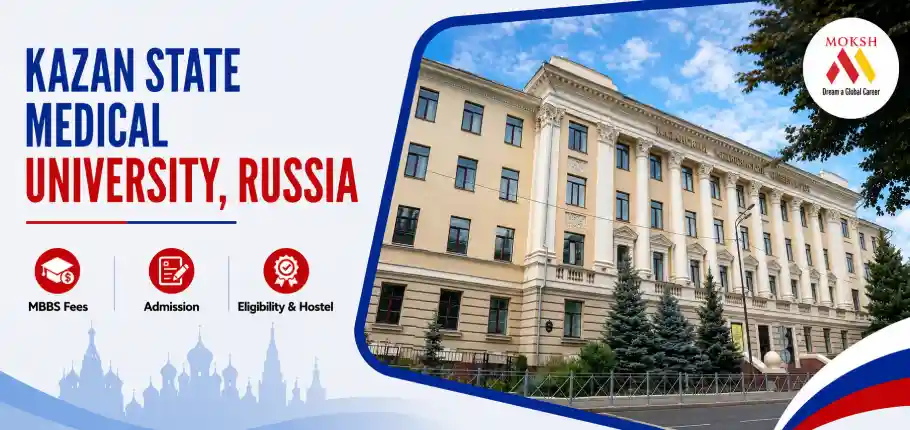
Kazan State Medical University is one of Russia's oldest medical schools. Indian students pick it for one reason above all: a full MBBS in Russia taught entirely in English, at a price Indian private colleges cannot match. Founded in 1814, KSMU ranks among the top ten medical universities in the country, with a BBB+ rating from RateOR.
Yes, Kazan State Medical University is NMC Approved. It fulfils all the criteria laid down under Foreign Medical Graduate Licentiate Regulations, 2021 in India. Russia's Ministry of Health governs the school directly, not a private trust, so clinical training follows strict national standards.
The MBBS runs six years, in full English medium, with no switch to Russian for lectures or exams. Total cost across six years lands near Rs.45 lakh, tuition, hostel, and basic charges included. Compare that to Rs.80 lakh to Rs.1 crore for a single private MBBS seat in India, and the math speaks for itself.
Graduates can sit India's licensing exams once they finish. This university fits NEET-qualified students who want early hospital exposure, a fixed fee structure, and a degree that holds up back home. Students chasing a bilingual program or a research-heavy campus should look elsewhere. Study MBBS at Kazan State Medical University if clinical training and cost certainty matter most to you.
Kazan State Medical University at a Glance
Here is the university in one table, the facts NEET students search for first.
| Parameter | Details |
|---|---|
| Established | 1814 |
| Location | Kazan, Republic of Tatarstan, Russia |
| Governing Body | Ministry of Health, Russian Federation |
| Medium of Instruction | English (all six years) |
| MBBS Duration | 6 years (60 months) |
| Internship | 12 months, co-located |
| Degree Awarded | Specialist Diploma in General Medicine (MD Physician) |
| NMC Status | FMGL 2021 compliant |
| WDOMS Status | Listed |
| ECFMG Eligibility | Eligible for USMLE Step 1 and Step 2 |
| Ranking | Top 10 in Russia; BBB+ (RateOR) |
| Student-Teacher Ratio | 1:15 |
| Teaching Hospitals | 18+ affiliated municipal hospitals |
| English Exam Required | None (no IELTS, no TOEFL) |
That table answers most of what parents search for at midnight. The rest of this guide fills in the why.
Why Choose Kazan State Medical University Russia?
Six reasons carry the most weight for Indian families:
200 years of clinical training
KSMU has run since 1814. That history means deep, existing ties with city hospitals, not new partnerships built just for international students.
Ministry of Health oversight
Russia's health ministry runs the school directly. Standards stay strict because a government body sets them, not a private owner chasing enrollment numbers.
True English-medium MBBS
All six years run in English. There is no surprise switch to Russian lectures in year four, a trap some other Russian universities set.
Hospital exposure from year three
Eighteen-plus affiliated municipal hospitals give students real patient contact early, not simulation labs alone.
Wide international recognition
NMC, WHO's WDOMS, ECFMG, the UK's GMC, and Canada's Royal College all recognize the degree.
Fixed tuition, real savings
Annual fees stay flat for six years, with no hidden hikes. The total still beats many Top medical universities in Russia competing on price, and it undercuts most MBBS Abroad options across Eastern Europe.
Students also join an established Indian community on campus, with seniors, informal mentors, and working mess systems already in place. Merit scholarships cut tuition by 5 to 15 percent for high scorers, one more reason KSMU keeps ranking among the Best medical universities in Russia for Indian applicants.
Kazan State Medical University MBBS Fees & Fee Structure
The full six-year MBBS costs approximately Rs.45,25,900. Tuition stays fixed at 6,36,000 RUB every year; only hostel and one-time charges shift.
| Year | Tuition (RUB) | Hostel (RUB) | Other Charges (RUB) | Estimated Total (INR) |
|---|---|---|---|---|
| Year 1 | 6,36,000 | 90,000-1,20,000 | 23,000 (visa, insurance, medicals) | Rs.8,95,900 |
| Year 2 | 6,36,000 | 18,000 | 6,000 | Rs.7,26,000 |
| Year 3 | 6,36,000 | 18,000 | 6,000 | Rs.7,26,000 |
| Year 4 | 6,36,000 | 18,000 | 6,000 | Rs.7,26,000 |
| Year 5 | 6,36,000 | 18,000 | 6,000 | Rs.7,26,000 |
| Year 6 | 6,36,000 | 18,000 | 6,000 | Rs.7,26,000 |
These figures use a conservative exchange rate: 1 RUB equals Rs.1.10, and 1 USD equals Rs.90. Real costs shift a little with the market, so it helps to build in a small buffer each year.
Set against India's private MBBS seats, which often run Rs.80 lakh to Rs.1 crore for a single seat, the Kazan State Medical University fees structure looks like a clear win on cost alone.
Students pay two ways. Carry cash, either US dollars or rubles, and deposit it after arrival. Or send a bank wire transfer from India before departure. Both methods work, though a wire transfer removes the risk of carrying large cash sums through airports.
Is Kazan State Medical University NMC Approved?
Yes. Kazan State Medical University meets all five requirements under India's Foreign Medical Graduate Licentiate Regulations (FMGL), 2021.
| NMC FMGL 2021 Requirement | KSMU Status |
|---|---|
| Minimum 54 months of instruction | 60 months provided |
| Single-institution 12-month internship | Built into the affiliated hospital network |
| Monolingual English medium | Fully English, running for over 20 years |
| National licensing exam in the home country | Primary Specialized Accreditation (PSA), registers graduates in Russia's Federal Register of Medical Workers |
| Biometrics and document verification | Nostrification of the Class 12 certificate through Rosobrnadzor, required for students staying past 90 days |
The Primary Specialized Accreditation exam is Russia's own licensing test. Passing it places a graduate on Russia's official medical register, and that registration satisfies the NMC's licensing rule back home. Once a graduate clears PSA and finishes the required internship, they become eligible to sit for India's FMGE or NExT exam.
This compliance sets KSMU apart from universities running shorter timelines or bilingual tracks that fall outside FMGL rules. These five points can be used by families as the whole picture, not just part of the picture when they are researching Kazan State Medical University NMC Approved status.
One practical tip: start the nostrification process in year one. Small name or spelling mismatches between Indian and Russian documents cause delays if caught late, so fixing them early saves trouble down the road.
MBBS Curriculum at Kazan State Medical University
The MBBS runs six years across twelve semesters. Early years build science fundamentals; later years shift into full clinical rotations.
| Year | Semesters | Core Subjects |
|---|---|---|
| Year 1 | 1-2 | Anatomy, Histology, Cytology, Embryology, Medical Chemistry, Conversational Russian |
| Year 2 | 3-4 | Physiology, Biochemistry, General Pathology, Microbiology, Immunology |
| Year 3 | 5-6 | Pathophysiology, Pharmacology, Medical Genetics, Clinical Medicine Basics, General Surgery |
| Year 4 | 7-8 | Internal Medicine, Surgery, Pediatrics, Psychiatry, Neurology, Obstetrics and Gynaecology |
| Year 5 | 9-10 | Ophthalmology, ENT, Oncology, Cardiology, Emergency Medicine |
| Year 6 | 11-12 | Clinical Internship, Hospital Rotations, State Exams |
Every core lecture, lab session, and exam runs in English throughout all six years. That is the Kazan State Medical University curriculum in structure, but language deserves a closer look, since it trips up many applicants researching online.
Students also take conversational Russian classes during years one through four. This is not a bilingual switch; it is patient-communication training. By year four, students can take a patient's history and join clinical rounds, and faculty still grade that clinical work in English.
Kazan State Medical University Eligibility Criteria for Indian Students
Six checks decide who qualifies:
- Age: at least 17 years old by December 31 of the admission year
- Class 12 PCB score: 50% aggregate for general category, 40% for reserved category
- Chemistry and Biology: 65% individually required under KSMU's own flagship program rule
- NEET-UG: a valid, qualifying scorecard from the current year or the past two years
- English proficiency exams: not required, no IELTS, no TOEFL
- Documents needed: passport, Class 10 and 12 marksheets, NEET scorecard
Meeting these six points covers Kazan State Medical University eligibility in full. Most NEET-qualified students clear this list without extra prep, since the bar sits close to India's own domestic MBBS cutoffs. Reserved-category students should keep certificates ready early, since verification on the Russian end takes time once documents arrive.
Kazan State Medical University Admission Process
Six steps move a student from application to campus:
Admissions for the main Kazan State Medical University admission cycle open in March and close between July and September. Seats for the English-medium program are limited, so applying early protects a spot before the cutoff.
Documents for MBBS Admission in Kazan State Medical University
The documents of Kazan State Medical University.
- NEET Qualified (2026/2025/2024)
- 10th/12th Board Marksheets
- HIV & Medical Reports
- Original Valid Passport
- Passport Size Photos
Hostel & Accommodation at Kazan State Medical University
KSMU runs six dormitories, all close to academic buildings and hospital sites.
- Rooms house two to three students each
- Central heating and hot water run through Kazan's cold winters
- High-speed Wi-Fi reaches every room
- Security staff run checkpoints and entry-pass systems around the clock, backed by CCTV in common areas
- Shared kitchens sit on every floor, with induction cooktops and microwaves for self-cooking
- Student-run Indian messes offer monthly vegetarian and non-vegetarian meal plans
KSMU Russia Student Life for Indian Students
Daily life outside class settles into a routine fast:
- Local markets near the dormitories stock Indian spices and staple ingredients
- An active Indian student community spans all six hostels, with informal mentoring from seniors
- Winters drop well below freezing, so central heating in every dorm matters more than air conditioning ever will
- Public transport, metro and buses, connects hostels to campus and hospital sites cheaply
- University staff help with registration, medical checkups, and biometric formalities through the first year
Most students settle in within the first semester, once the language, the cold, and the class schedule fall into a rhythm.